Cognitive strategy · Online, worldwide
Natalie Mackenzie, cognitive strategist for leaders, founders and their teams
I help business owners, senior professionals and the teams around them understand how the brain performs under load, then organise work around it. Individuals usually start with a measured cognitive assessment (£449). Organisations book talks, workshops and programmes for managers and teams. Everything can run online, for clients anywhere.
Based in Kent, UK. Sessions on Zoom, so location doesn’t matter.

Chair
International Society for Cognitive Rehabilitation
Founder
BIS Services, winner of the NR Times People’s Choice Award 2024
Trained in
BSc Psychology, MSc Cognitive Neuropsychology
Experience
Working in cognitive rehabilitation since 2002
For individuals
Five ways in, each priced on the page
Pick the depth that suits you. If you are not sure, the free call is there to work that out.
Start here
Free Cognitive Consult
Free
A 30-minute Zoom call. We look at what is getting in the way of clear thinking and whether working together makes sense.
Track
30-day Brain Monitor
£9.97
Under a minute a day on your phone. After 30 days you can see when you think best and what drains you.
Measure
Cognitive Health Assessment
£449
About 40 minutes of online cognitive tasks, a written report on how you perform, and a one-hour debrief with me.
Group programme
The C.O.G.S. Programme
Prices shared with the waitlist first
Nine weeks, live and online, in a small cohort. Next cohort starts January 2027.
One to one
The Cognitive Edge
From £4,997
Three months of one-to-one cognitive and business strategy, with an in-person strategy day.
For organisations
Cognitive performance training for managers and teams
Your people’s thinking is the work. I help managers and teams see how attention, fatigue and pressure shape their decisions, then change how work is organised so they can think clearly when it counts.
For managers
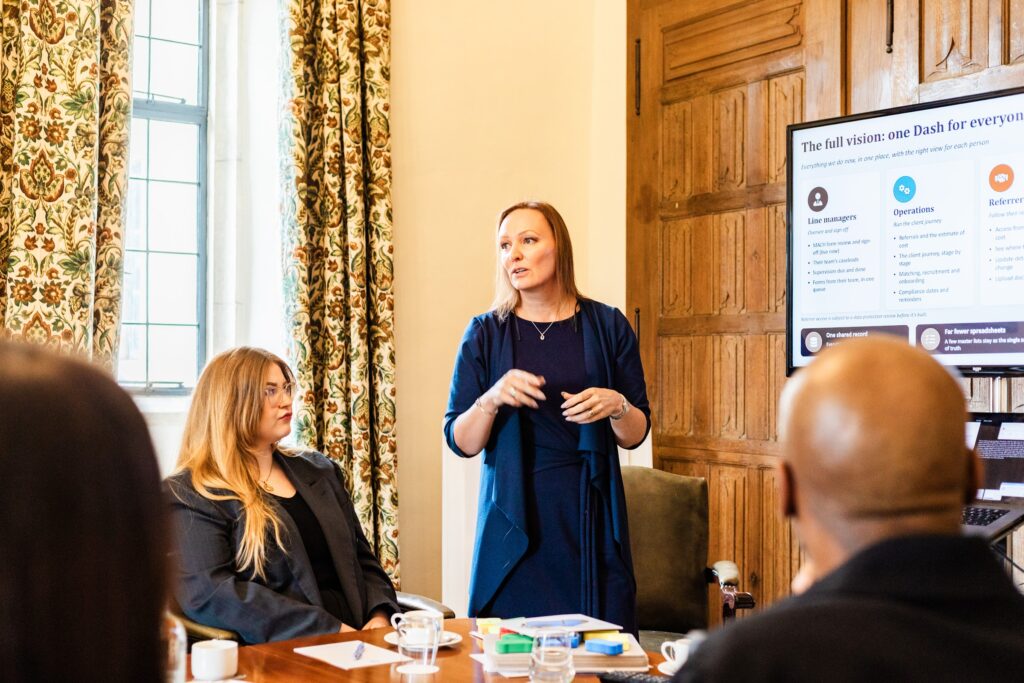
Understand cognitive performance, spot overload in a team and plan workload so people can do their best thinking.
For teams
Shared habits for focus, interruptions and recovery, built around the team’s real week.
Neuroinclusion
Practical tools for line managers to design work around how different brains function.
Talks and keynotes
Evidence-led talks for conferences, leadership events and all-hands, in person or online.

Who this is for
People whose work is their thinking
Clients usually arrive at a point where the cost of thinking badly has gone up. Common reasons:
- You run a business and every decision still lands on you
- You have stepped into a bigger role and your old ways of working no longer hold
- You are in midlife, have noticed your focus or memory shift, and want facts instead of guesswork
- You have watched a parent’s memory decline and want to act early on your own brain health
- You have a late ADHD diagnosis and want strategies built around how you actually think
If you are early stage and stretching to afford this, it is the wrong time, and I will tell you so on the call.
The evidence
Why your brain belongs on the business agenda
Three findings I build the work on. Each one is referenced so you can check it.
Interruptions cost more than the moment
Gloria Mark’s workplace studies at the University of California, Irvine found people took around 23 minutes, on average, to return to an interrupted task. Across a day of messages and meetings, that adds up.
Unfinished work follows you
Sophie Leroy’s 2009 experiments showed that switching away from an unfinished task leaves “attention residue”, and performance on the next task drops. How you sequence your day changes how well you think.
Long-term brain health is partly in your hands
The 2024 Lancet Commission estimated that around 45% of dementia cases could in theory be prevented or delayed by tackling 14 risk factors across life. It is a population model, so it cannot promise anything for one person, but it shows where effort counts.
Sources: Mark, G., Gudith, D. & Klocke, U. (2008) CHI; Leroy, S. (2009) Organizational Behavior and Human Decision Processes; Livingston, G. et al. (2024) The Lancet 404:572-628.
The method
C.O.G.S., the framework behind everything I do
Four phases. Every client works through them, whether in the group programme or one to one.
C
Cognitive Baseline
Measure how your cognition performs now, so the plan is built on your brain.
O
Organised Operations
Structure your work around how attention and cognitive load behave.
G
Guard and Grow
Sleep, stress, recovery and the habits linked to cognitive reserve.
S
Sustainable Success
A written Blueprint you can measure and keep using after we finish.
Clients
What clients say
“The report and recommendations Natalie produced at the end of our 12 sessions was incredibly valuable to help me better understand how my brain works and how to get the best out of my work. From this HR and my Line Manager created a tailored development plan based on the recommendations which helped me settle into my role and improved my performance significantly.”
Client, 12-session workplace programme
“Natalie helped me understand how to better utilise my strengths and manage and improve the things that don’t come as naturally (not necessarily weaknesses!), how my brain works in specific situations and what it needs to function at its best.”
Client, one-to-one cognitive strategy
Media
Articles, podcasts and talks
Every item links to the original piece.
Open Access Government · Jan 2026
SheCanCode · Jul 2026
Bdaily · Aug 2025
Podcast · Jan 2026
Podcast · Jan 2026
Bring Your Product Idea to Life: cognitive health for entrepreneurs
NR Times · Jul 2025
Also featured in






And in Psychologies, Metro, Red, Business Insider, Your Horse and Take a Break.
Questions
Common questions
How much does it cost to work with you?
The assessment is £449 including a one-hour debrief. One-to-one work starts at £4,997 for three months. C.O.G.S. prices go to the waitlist first. The first call is free.
Can I work with you from outside the UK?
Yes. The assessment is completed on your own laptop and every session runs on Zoom. The only in-person element is the strategy day in one-to-one work.
Can the assessment tell me if I will get dementia?
No. It measures how your thinking performs now and gives you a baseline to re-test. It does not diagnose or predict dementia. If you are worried about memory changes, see your GP.
How is this different from executive coaching?
Coaching usually works from what you tell the coach. I start from measured cognitive performance and two decades of cognitive rehabilitation, then apply it to your business decisions.
Free · 13 questions · 3 minutes
Take the free Brain Load Audit
For business owners, founders and leaders carrying a heavy mental load. Answer 13 one-tap questions about your sleep, stress, workload, movement, mood and hormones, and get a personal result showing which of these is driving your brain fog and overload, and what to change first. Your result arrives by email with my Brain Health Cheat Sheet.
A self-reflection tool based on your own answers. It does not test or score your brain health.
What you get
- Your main driver
- Two or three changes to make this week
- The Brain Health Cheat Sheet
Next step
Book a free 30-minute Cognitive Consult
We will talk through what is getting in the way of clear thinking, what you want to change, and which option fits. No obligation, and no hard sell.